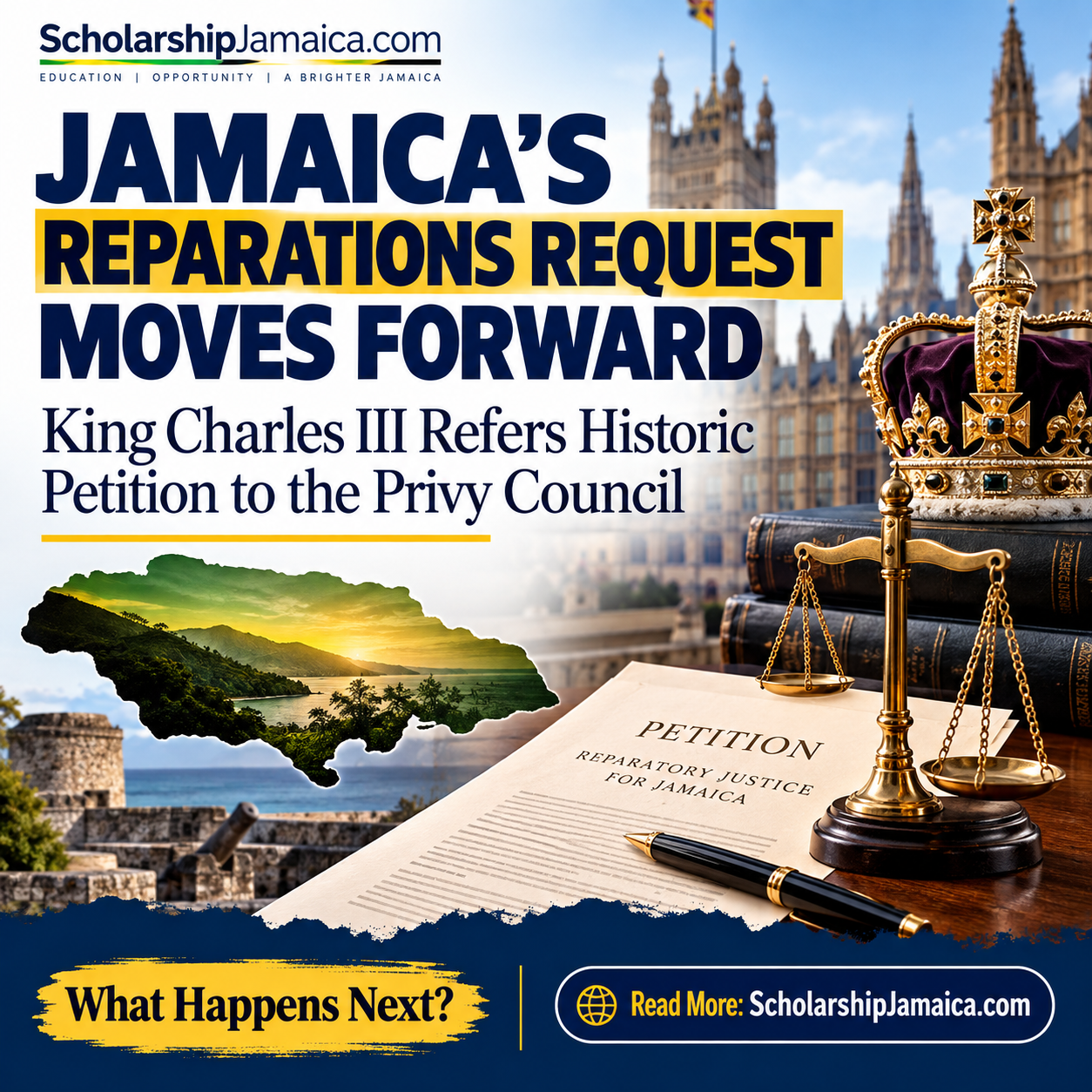

The Jamaica slavery reparation movement has entered a significant new phase after King Charles III referred Jamaica’s historic petition concerning slavery and reparatory justice to the Judicial Committee of the Privy Council.
The development follows Jamaica’s formal submission of a petition to the King on September 7, 2026. The petition asks fundamental legal questions about the forced transportation and enslavement of Africans in Jamaica under British rule and whether the United Kingdom has a legal obligation to provide a reparatory remedy.
Jamaica’s Minister of Culture, Gender, Entertainment and Sport, Olivia Grange, announced in Parliament that the King had referred the petition to the Judicial Committee of the Privy Council.
The referral does not mean that Jamaica has been awarded financial reparations. Nor does it represent a final legal determination that Britain owes Jamaica compensation. Instead, it moves the country’s reparations initiative into another stage, where the legal questions presented by Jamaica can be formally considered.
For Jamaica and the wider Caribbean reparations movement, the development adds a legal dimension to a campaign that has been pursued for decades.
What Is the Jamaica Slavery Reparation Petition?
The Jamaica slavery reparation petition focuses on the legality of the forced transportation and enslavement of Africans in Jamaica during British colonial rule.
The Jamaican Government formally filed the petition with King Charles III in London on September 7, 2026. Jamaica is relying on Section 4 of the Judicial Committee Act 1833, which provides a mechanism through which certain legal questions may be referred by the Crown to the Judicial Committee of the Privy Council for consideration.
The Government chose this route after examining how questions surrounding slavery, historical responsibility and reparatory justice could receive formal legal consideration. Importantly, Jamaica’s petition does not specify a monetary amount.
Instead, the Government is first seeking answers to fundamental legal questions concerning slavery and Britain’s historical obligations before determining what subsequent action may be appropriate.
Three Legal Questions at the Centre of Jamaica’s Petition
The Jamaica slavery reparation petition asks three major questions. The first is whether the seizure, transportation and enslavement of Africans in Jamaica as chattel were ever lawful under English law. The second considers whether the forced transportation and enslavement of Africans violated international legal principles applicable at the time.
The third asks whether the United Kingdom has a legal obligation to provide a reparatory remedy to the Jamaican people for those actions and their continuing consequences.
These questions distinguish the current initiative from a straightforward demand for financial compensation. Jamaica is seeking legal guidance that could help establish the foundation for future discussions about responsibility, remedies and reparatory justice.
King Charles Refers Jamaica’s Petition to the Privy Council
The next major development came when King Charles III referred Jamaica’s petition to the Judicial Committee of the Privy Council. Culture Minister Olivia Grange informed Jamaica’s House of Representatives of the development on September 22.
The referral means Jamaica has successfully passed the first procedural stage of its strategy: getting the legal questions before the Judicial Committee. However, it is important to distinguish a referral from a judgment.
The Judicial Committee has not yet determined whether Britain has a legal obligation to provide reparations to Jamaica. Jamaica must now await further directions concerning how the matter will proceed. Attorney General Dr Derrick McKoy is expected to play a central role in Jamaica’s legal representation as the process develops.
Why Jamaica Chose This Legal Route
Jamaica has pursued reparations through political, diplomatic and regional channels for years, particularly through the wider Caribbean reparations movement. The latest initiative adds a formal legal strategy.
Section 4 of the Judicial Committee Act 1833 allows certain questions to be referred to the Judicial Committee for advice. Jamaica is therefore using a British statute that is almost two centuries old to raise questions about actions that occurred under British colonial rule.
Prime Minister Andrew Holness has described the petition as a constructive pathway toward reparatory justice and has emphasised that it begins with fundamental legal questions rather than a specified compensation demand. The approach also complements the broader work of Jamaica’s National Council on Reparations and the CARICOM Reparations Commission.
The History Behind Jamaica Slavery Reparation
Understanding the Jamaica slavery reparation movement requires understanding Jamaica’s colonial history. For centuries, Africans were forcibly transported across the Atlantic and enslaved throughout the Caribbean. Jamaica became one of Britain’s most important plantation colonies, with enslaved Africans providing labour that supported the production of commodities such as sugar.
Enslaved people were legally and economically treated as property within the plantation system and were subjected to severe restrictions, exploitation and violence. The abolition of the British slave trade in 1807 did not immediately end slavery. Full emancipation in the British Caribbean came decades later, following the Slavery Abolition Act and the subsequent apprenticeship period.
Modern reparations advocates argue that the consequences of slavery did not simply disappear with emancipation. They point to inequalities in education, wealth, health, land ownership and economic development that they say were influenced by colonial systems.
Opponents or sceptics of reparations have raised different questions, including how responsibility should be determined across generations and what forms of remedy would be legally or practically appropriate. Jamaica’s petition seeks to move part of that debate into a formal legal setting.
The Zong Massacre and Jamaica’s Reparations Campaign
One historical event closely connected with Jamaica’s 2026 initiative is the Zong massacre. In 1781, the British slave ship Zong departed West Africa carrying hundreds of enslaved Africans toward Jamaica.
During the voyage, more than 130 enslaved Africans were deliberately thrown overboard. The ship’s owners later pursued an insurance claim involving those who had been killed, illustrating the way enslaved Africans were treated as commercial property within the transatlantic system.
The incident eventually became an important event in the history of the British abolition movement. September 7 was symbolically significant for Jamaica’s petition because the date also marked the anniversary period associated with the Zong’s 1781 voyage to Jamaica.
The Government has incorporated this history into its broader argument for examination of slavery and reparatory justice.
Jamaica Slavery Reparation Is About More Than Money
A common misconception surrounding reparations is that the issue relates exclusively to financial payments. Jamaica’s current petition makes no specified monetary claim.
The broader Caribbean concept of reparatory justice encompasses several possible areas, including historical acknowledgement, education, healthcare, cultural restoration, economic development and the return of cultural heritage.
Prime Minister Holness has described reparatory justice in terms that include truth, acknowledgement, justice, repair, compensation, development and reconciliation. The current legal petition begins with determining whether a legal obligation exists.
Questions concerning the form or value of any potential remedy would come later and would depend on the outcome of the legal and political processes.
Cultural Repatriation and Jamaican Heritage
Another component of Jamaica’s broader reparations discussion involves the return of cultural objects removed from Jamaica during the colonial period. This is more accurately described as repatriation, which should not be confused with reparation.
Reparation concerns efforts to repair or provide remedies for historical wrongdoing. Repatriation generally refers to returning people, cultural objects or other property to their country or community of origin.
During the Jamaican delegation’s visit to Britain, cultural repatriation was also part of discussions surrounding Jamaica’s colonial heritage. The return of cultural objects has become an increasingly important international issue as museums and governments examine how artefacts acquired during colonial periods entered European collections.
Britain’s Position on Slavery Reparations
The British Government has historically opposed paying financial reparations for slavery while acknowledging the brutality and suffering associated with the transatlantic slave trade. King Charles has also previously spoken publicly about the history and enduring impact of slavery.
Those statements, however, are different from determining whether the United Kingdom has a legal obligation to provide a remedy. That distinction is one reason Jamaica’s Privy Council strategy is significant.
Rather than relying solely on political negotiations, Jamaica is asking for legal consideration of the underlying questions.
Why Jamaica’s Case Matters Across the Caribbean
The Jamaica slavery reparation initiative is being closely watched beyond Jamaica. CARICOM governments have pursued reparatory justice for years through the CARICOM Reparations Commission and other diplomatic initiatives.
Jamaica’s petition has also received support from other CARICOM states and Ghana. Other Caribbean governments may therefore closely examine the Jamaican experience as they consider their own legal, diplomatic and political approaches.
However, Jamaica’s petition does not automatically establish that other Caribbean nations will follow the same route, nor does the referral itself establish a legal precedent. Much will depend on what the Judicial Committee ultimately says about the questions presented.
What Happens Next With Jamaica Slavery Reparation?
Jamaica must now await procedural directions from the Judicial Committee of the Privy Council. Several important questions remain unresolved.
How will the Judicial Committee examine laws and legal principles dating back centuries? What conclusions could it reach concerning the legality of slavery? Could an advisory finding create the foundation for negotiations between Jamaica and Britain? And what form could reparatory remedies eventually take if an obligation were recognised?
Those questions cannot yet be answered. What is clear is that Jamaica has moved its reparations campaign into a new legal phase.
Jamaica Slavery Reparation Enters a New Chapter
The Jamaica slavery reparation petition represents one of the country’s most consequential recent attempts to obtain formal consideration of Britain’s historical role in slavery.
Jamaica is asking whether the forced transportation and enslavement of Africans was lawful, whether international legal principles were violated and whether the United Kingdom has an obligation to provide a reparatory remedy.
King Charles III’s referral of those questions to the Judicial Committee of the Privy Council does not determine the outcome. It does, however, allow Jamaica’s legal strategy to move forward.
For Jamaicans at home and throughout the diaspora, the process is likely to generate further discussion about slavery, colonialism, historical responsibility, cultural heritage and the meaning of reparatory justice in the 21st century. As Jamaica awaits the next stage of the Privy Council process, the Jamaica slavery reparation initiative will remain an important issue to watch across Jamaica, the Caribbean and the wider international community.
Scholarship Jamaica will continue to follow developments surrounding Jamaica slavery reparation, reparatory justice and other major national issues affecting Jamaicans at home and throughout the diaspora.








Comments are closed