

Introduction
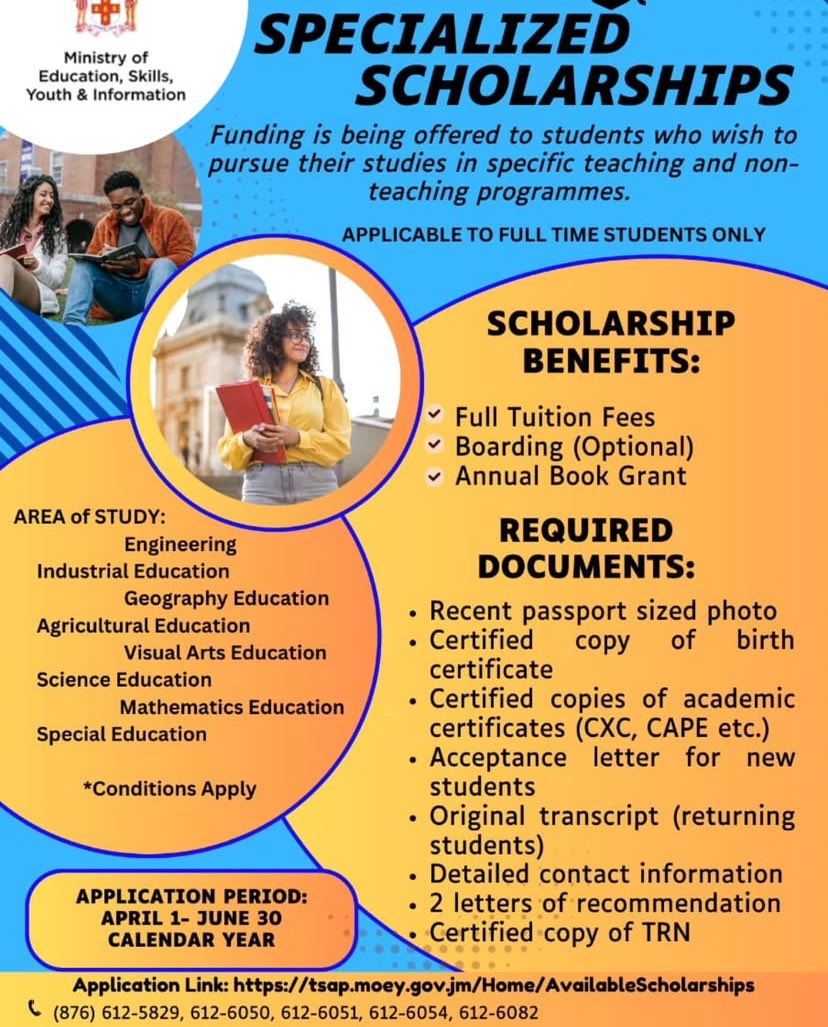
Jamaica’s education system already uses a mix of public scholarships, grants, and concessional student financing—through agencies and programmes such as the Ministry of Education and Youth’s Tertiary Student Assistance Programme (TSAP), the Students’ Loan Bureau (SLB), the CHASE Fund, and targeted scholarships such as the Ministry of Finance’s STEM scholarships. Ministry of Finance & Public Service.
However, climate shocks and other major disasters can quickly reduce household ability to pay, disrupt attendance, and raise dropout risk—especially among disadvantaged learners—making post-disaster scholarships and bursaries a practical “continuity tool,” not just a social benefit.
This article (research-paper style) proposes an integrated financing framework: (1) scale and better target scholarships and bursaries, (2) mobilize new revenue sources (public, private, and diaspora), (3) use disaster risk financing to create rapid-response education funding, and (4) strengthen governance and delivery so funds reach students quickly and transparently.
1) Jamaica’s current foundation: what exists to scale
Jamaica is not starting from scratch. Several mechanisms already finance students and can be expanded or re-engineered into a stronger national “scholarships and bursaries” ecosystem:
- TSAP / Ministry of Education and Youth provides grants and scholarships through an application window and clear eligibility rules (e.g., accredited institutions, GPA requirements, age bands, and bonding rules above certain award thresholds). Tertiary Assistance
- Budgetary support for scholarships has been reported through the education ministry’s scholarship programme allocations. Jamaica Information Service
- Students’ Loan Bureau (SLB) provides tertiary financing products and also supports targeted assistance (including arrangements tied to JAMVAT and grant-in-aid expansions for lower-income/PATH households). Students’ Loan Bureau
- CHASE Fund provides scholarships and educational grants across sectors (culture, health, sports, education), with published criteria and scholarship cycles. CHASE Fund
- HEART/NSTA Trust supports TVET scholarships and policy actions that expand affordability and access in skills training. heart-nsta.org
- MOFPS STEM scholarship programme demonstrates how a ministry can run a multi-year, costed scholarship initiative in partnership with institutions and financing bodies. Ministry of Finance & Public Service
Key takeaway: Jamaica’s priority is not “whether to do scholarships and bursaries,” but how to scale, stabilize funding, and make delivery fast, especially after shocks.
2) Why disasters matter for scholarships and bursaries
Evidence across regions shows disasters can reduce enrolment, disrupt progression, and intensify inequities—conditions that scholarships and bursaries can directly counteract by keeping students enrolled and covering urgent costs. A 2024 systematic review reported negative impacts of natural disasters on higher-education enrolment processes and outcomes, particularly for disadvantaged groups. Findings from Puerto Rico after Hurricane Maria show measurable adverse educational effects, heightened among vulnerable students—supporting the rationale for rapid education financing after disasters. Natural Hazards Center
Globally, emergency student funding models exist and can inspire Jamaica’s approach:
- The Institute of International Education (IIE) issued emergency micro-grants to students impacted by hurricanes, flooding, and conflict across multiple regions (including the Caribbean). IIE
- In the U.S., federal and state actions show how education aid can be structured as emergency impact funding and emergency scholarship grants after hurricanes. Government Accountability Office
Policy implication: Jamaica should treat post-disaster education financing as a “standing capability”—pre-funded rules, triggers, and delivery channels—rather than an ad-hoc appeal every time a storm hits.
3) A national strategy to increase education financing through scholarships and bursaries
A. Create a “National Scholarships and Bursaries Financing Framework”
What it is: A single coordinated financing framework that aligns TSAP, SLB targeted supports, CHASE scholarships, TVET scholarships, and ministry-specific awards (like STEM) under shared goals and reporting standards—without removing each programme’s identity.
Why it increases financing:
- It reduces duplication and leakage (same student missing support while another gets overlapping awards).
- It creates a clearer “pipeline” for donors and private sector co-funding (businesses prefer predictable governance).
- It improves negotiating power for external financing and concessional support.
How: Publish (1) a consolidated annual financing plan, (2) unified definitions (scholarship vs bursary vs grant vs loan subsidy), (3) minimum service standards (decision time, appeals, payment timelines), and (4) national priority fields tied to labour strategy (e.g., teaching, nursing, STEM, climate resilience skills).
Jamaica already has public information portals and programme rules; the opportunity is to connect them into a coherent “system.” Ministry of Finance & Public Service
B. Expand the size of the pie through increase education financing: new, dedicated revenue streams
To sustainably grow scholarships and bursaries, Jamaica can mix domestic revenue innovations with co-financing.
- Earmark a small, transparent levy for education opportunity
Many countries fund training via earmarked levies; Jamaica can adopt a modern version for tertiary access and resilience—kept modest, time-bound, and publicly audited. Earmarking must be designed carefully to preserve fiscal flexibility, but it can work if governance is strong and the public sees measurable results. - Public-Private Scholarship Matching (PPM)
Government matches private scholarships (e.g., 1:1 or 1:0.5) when donors fund priority groups (PATH households, rural parishes, disability inclusion) or priority fields (teaching, nursing, STEM, TVET). This turns corporate social responsibility into predictable national financing. - Diaspora scholarships and “education bonds”
A structured diaspora fund—paired with transparent reporting and visible student outcomes—can mobilize stable foreign currency contributions. The key is governance: audited financials, low admin costs, and clear selection criteria. - Results-based financing
Tie a portion of budget increases to measurable outputs: completion rates, employment outcomes, or service commitments (bonding where appropriate). TSAP already has bonding rules for higher awards; apply similar logic program-wide but with student protections and clear terms. Tertiary Assistance
C. Improve targeting so limited funds produce larger national impact
Increasing financing is not only about more money—it’s also about better allocation.
Move toward “precision bursaries” for vulnerability + continuity
After disasters, families face temporary liquidity shocks (rent, transport, device replacement, food). A bursary designed as a fast, small-to-medium micro-grant can prevent dropout more efficiently than waiting on large awards. This is just another way to increase education financing through scholarships in Jamaica.
Use existing social registries and programme linkages
Jamaica already has pathways for means-linked support (e.g., PATH-related considerations appear in SLB grant-in-aid expansions). Students’ Loan Bureau Build on that: automatic bursary eligibility for affected students in declared disaster zones, subject to verification.
Adopt a “two-lane” model
- Lane 1: Merit scholarships for national talent and strategic fields.
- Lane 2: Need-based bursaries and persistence grants to protect enrolment and completion—especially post-disaster.
4) Building post-disaster scholarship capacity: financing that triggers automatically
A. Establish an “Education Continuity Fund” with disaster triggers
Instead of relying on emergency reallocation, Jamaica can pre-design a fund that releases money rapidly when objective thresholds are met (e.g., national disaster declaration, rainfall/flood index thresholds, parish-level damage metrics).
Why this is globally aligned: International systems increasingly promote pre-arranged disaster finance—so funding is faster and more predictable than late appeals. ScienceDirect
B. Link to global climate/disaster finance windows
Small island states often rely on concessional resilience finance; Jamaica can explicitly integrate “education continuity scholarships and bursaries” into climate resilience proposals, because human capital protection is a resilience outcome. The OECD has documented how concessional finance flows support SIDS’ climate and disaster resilience—this is a logical pathway for education components inside resilience programmes. OECD
Also, global climate policy is evolving toward addressing loss and damage; Jamaica should ensure education continuity is visible in national priorities when such funds become accessible through multilateral channels. UNDP
C. Learn from “education in emergencies” financing models
Education Cannot Wait (ECW) exists specifically to mobilize rapid financing for education in crisis contexts, illustrating how pooled, flexible financing can support continuity when shocks occur. Education Cannot Wait+1 While ECW is oriented largely to humanitarian contexts, the operational logic—fast disbursement, pooled donor support, and measurable outputs—can be adapted domestically for disaster years.
5) Delivery reforms: how to make scholarships and bursaries faster, fairer, and more trusted
Even with more financing, increase education financing programmes fail if students can’t access funds on time.
A. One national application and verification layer (with programme “routes”)
A single digital intake can route applicants to TSAP grants, SLB grant-in-aid supports, CHASE scholarships, and sector awards—reducing paperwork and drop-off. TSAP already uses an online portal and publishes its annual window; build from there. Tertiary Assistance
B. Pay institutions directly where possible, plus a student micro-grant rail
- Tuition: pay institutions directly to reduce misuse and speed registration.
- Living costs: pay a capped micro-grant to students post-disaster for transport, devices, and housing stabilization.
C. Standardize transparency: publish outcomes and time-to-decision
Publish anonymized dashboards: applications received, approvals, average days to payment, parish distribution, and completion outcomes. This strengthens public trust and improves donor willingness to co-fund.
D. Strengthen audit and governance for revolving funds and grants
Jamaica has a history of auditing education financing entities (e.g., SLB revolving fund oversight). Continuous improvements in governance protect sustainability and public confidence. auditorgeneral.gov.jm
6) Implementation roadmap (practical and sequenced)
Phase 1 (0–6 months): Design + quick wins
- Publish the national financing framework and definitions for scholarships and bursaries.
- Establish disaster trigger rules for rapid bursary release (pilot in high-risk parishes).
- Begin private-sector matching pilot in 2–3 priority fields.
Phase 2 (6–18 months): Scale + integrate
- Launch single intake + routing system across major programmes.
- Create the Education Continuity Fund (seeded by budget + partners).
- Formalize diaspora scholarship partnerships with audited reporting.
Phase 3 (18–36 months): Institutionalize
- Expand results-based financing (completion and employment outcomes).
- Integrate resilience/climate finance proposals with “education continuity” components.
- Annual public reporting and independent evaluation.
Increase Education Financing Conclusion
To increase education financing through scholarships and bursaries, the Government of Jamaica should pursue a combined strategy: scale existing programmes (TSAP, SLB targeted supports, CHASE, TVET scholarships, STEM initiatives), diversify revenue via private matching and diaspora vehicles, and—critically—build a standing post-disaster education financing capability with pre-agreed triggers and rapid disbursement.
Evidence from disaster-affected contexts shows education participation and outcomes suffer after shocks, especially for vulnerable groups, making well-designed bursaries and emergency grants one of the most cost-effective tools for protecting human capital. PMC
The result is not only higher enrolment and completion, but a more resilient Jamaica—where disasters don’t permanently derail students’ futures.








Comments are closed